Leadership & Transformation
10 Years in Transformation: What Never Changes
People, clarity, trust and steady progress remain at the heart of transformation.
Tosh Bhasin · Nov 2025 · 2 min read
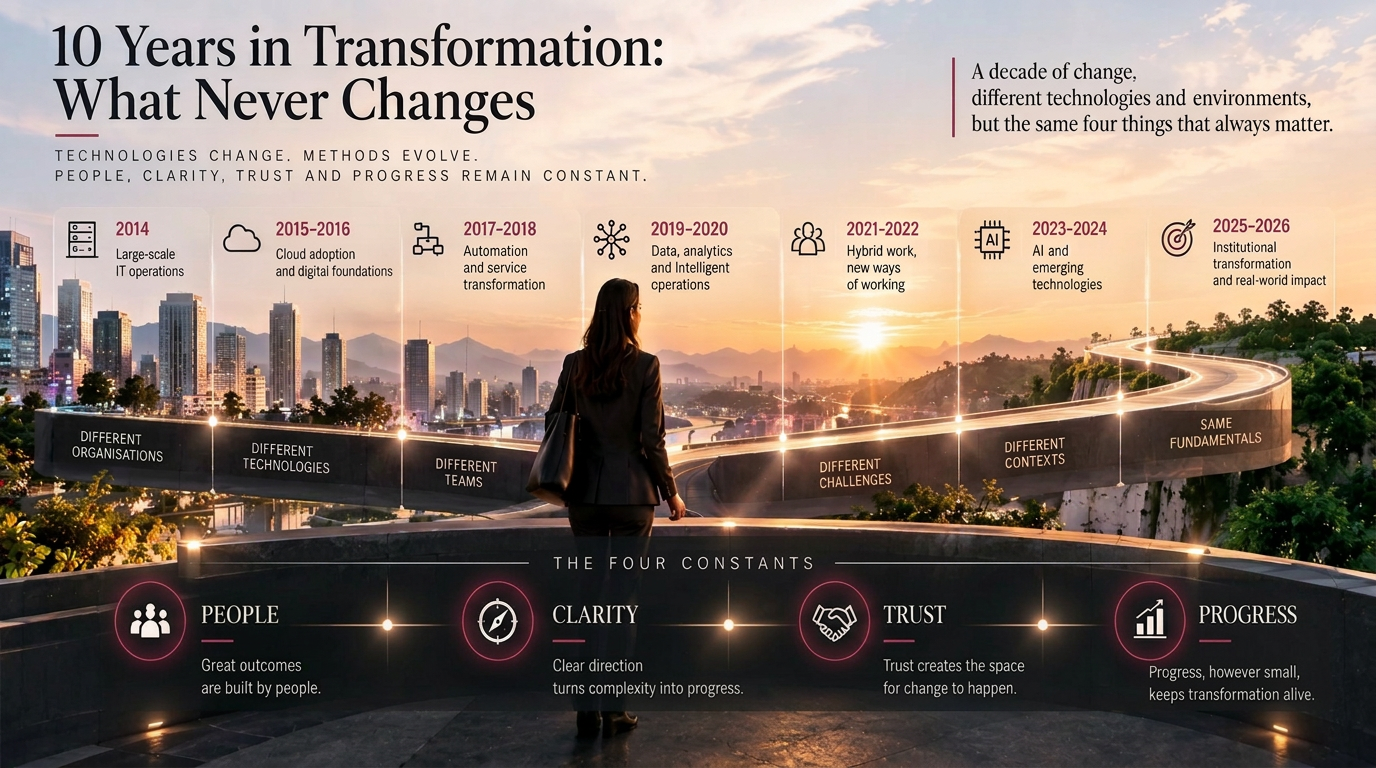
Technology changes every year. But some truths about transformation never do.
After more than a decade in transformation, I’ve seen tools, trends and frameworks come and go. AI, Agile, automation and cloud have each reshaped how we work. But the essence of transformation remains constant.
What never changes
- People drive transformation, not platforms. The most advanced systems fail if the culture isn’t ready to adapt.
- Clarity beats complexity. Simpler goals, cleaner governance and clear ownership will always outperform layered hierarchies and endless approvals.
- Trust fuels change. Without it, teams resist. With it, they innovate.
- Progress over perfection. The best transformations evolve; they’re not delivered as finished products.
The longer I work in this space, the more I realise transformation isn’t about speed. It’s about staying steady while everything else changes.
Frameworks evolve. Technologies mature. But transformation, at its core, is still a people story.
Put the constants into practice
These truths are useful because they give us a way to assess change without becoming distracted by the latest tool. A new platform still needs people who understand its purpose. A new framework still needs clear ownership. A faster delivery cycle still needs trust between the teams doing the work.
Clarity brings those elements together. When the goal is understandable and responsibility is visible, people can connect their contribution to the outcome. Complexity makes that connection harder to see. Simpler goals and cleaner governance help teams keep their attention on what matters.
Stay steady, keep learning
Progress over perfection means accepting that the work will evolve. It leaves room to learn and improve as the organisation changes. Staying steady is about keeping the purpose clear through that evolution, while allowing the approach to develop. The tools will continue to change. Our responsibility to the people living with that change remains.