Digital Transformation
Digital Technology: The Missing Pillar in India's GCC Playbook
India's GCCs are evolving from delivery centers into strategic hubs. The technology foundations established from day one can determine how far and how effectively they scale.
Tosh Bhasin · Oct 2026 · 5 min read
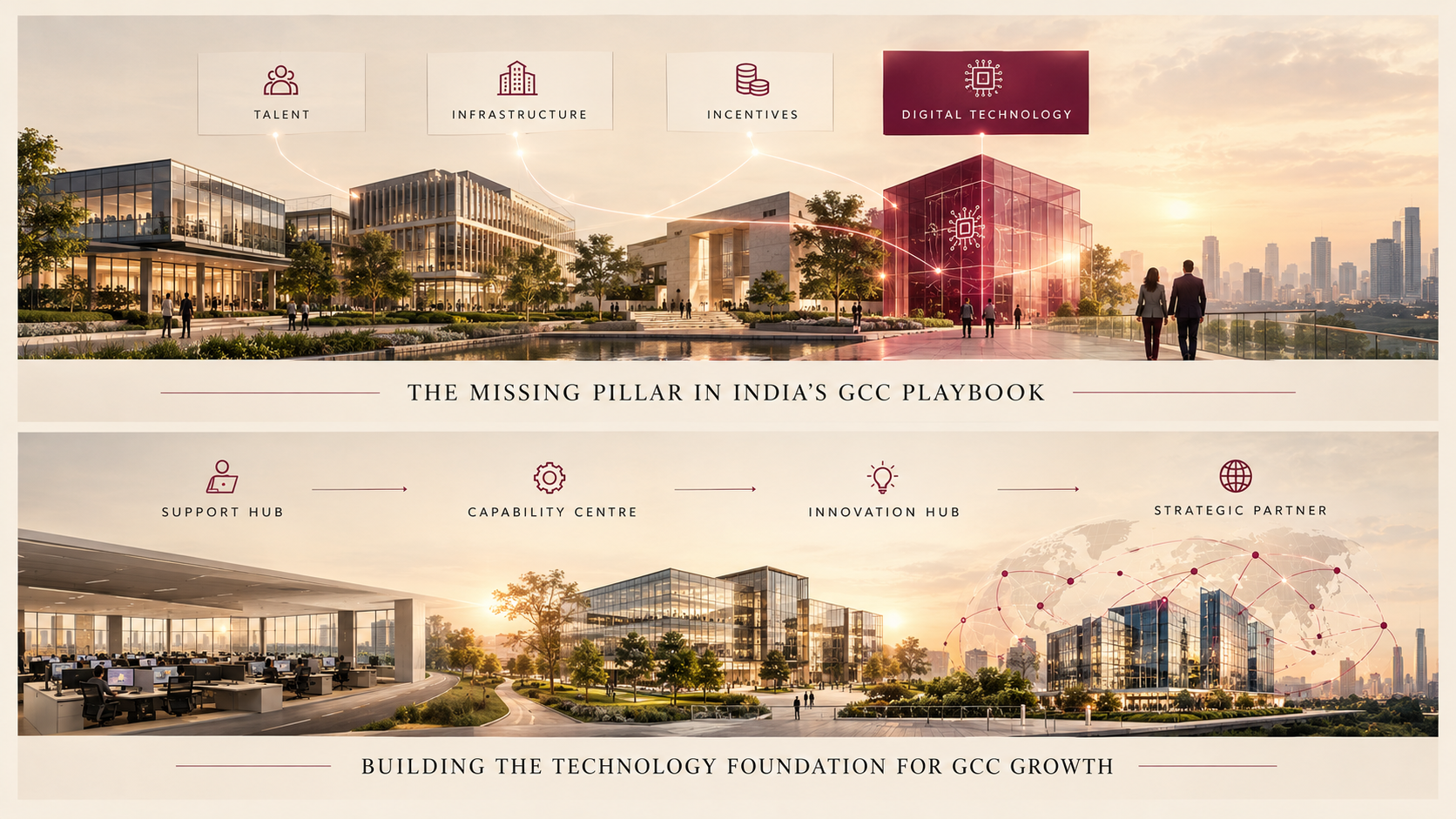
Most GCC setup plans focus on three essentials: talent, real estate and incentives.
I believe a fourth deserves equal attention from day one: digital technology.
Technology decisions made while establishing a centre can determine how far it progresses later. Organisations that defer them may spend years addressing fragmented systems, inconsistent processes, security gaps and costly technology choices.
Those that build technology into their GCC strategy from the outset are better positioned to scale capabilities, own global products and platforms, and take on greater strategic responsibility.
As India's GCC ecosystem moves beyond traditional delivery and support, the question is no longer simply how quickly a centre can be established. It is whether the centre is equipped to take on increasingly complex and business-critical mandates.
India's GCC story is evolving
GCCs are increasingly moving beyond their traditional role as offshore delivery centres. Many are becoming hubs for engineering, product development, analytics, AI, cybersecurity and enterprise transformation.
That changes how organisations need to think about establishing them.
Talent, location, infrastructure and incentives remain important. But if the ambition is for a GCC to eventually own global platforms, products, data capabilities or critical business processes, its digital foundation needs to be considered alongside its physical and organisational foundation.
Why digital technology is a pillar, not a support function
Technology is often treated as something that follows the establishment of a GCC: set up the office, hire the teams, establish operations and then determine the technology requirements.
That sequence may work when the centre's mandate is primarily execution. It becomes much harder when the ambition is strategic ownership.
A GCC expected to scale globally needs an architecture that supports growth without unnecessary complexity, clarity around data ownership and governance, secure integration with enterprise platforms, and the ability to introduce automation, analytics and AI without repeatedly rebuilding its technology environment.
This is why I see digital technology as a fourth foundational pillar of GCC strategy, alongside talent, infrastructure and the operating environment.
The goal is not to replicate every system used by headquarters or create an independent technology silo. It is to establish an architecture that integrates with the global enterprise while providing enough flexibility to innovate and scale.
The ambition of a GCC may be strategic, but without the right digital foundation, its ability to become strategic will always be constrained.
Day-zero technology decisions
Several decisions deserve attention before a GCC begins scaling.
1. Define the enterprise architecture
Determine which platforms remain global, which capabilities can be owned locally and how systems will integrate across the enterprise. Early architecture decisions can prevent years of fragmented applications and expensive integration work.
2. Establish the data strategy
Define what data the GCC will consume, generate and potentially own, including architecture, quality, lineage, access and accountability. Without this foundation, analytics and AI can quickly become constrained by inconsistent or unreliable data.
3. Design governance and decision rights
Clarify who can make decisions about platforms, architecture, data, security and technology investment. As the GCC matures, governance should evolve with its mandate rather than remain permanently dependent on headquarters.
4. Build security and compliance into the architecture
Security should be designed into the operating model, not added later. Applicable data-protection obligations, sector requirements, cross-border data flows and enterprise regulatory commitments should influence the technology model from the outset.
5. Build for integration
GCCs operate within complex global technology environments. APIs, integration platforms and interoperability standards are therefore critical to introducing new capabilities without creating additional point-to-point dependencies.
6. Plan cloud and infrastructure for the future mandate
Cloud architecture, connectivity, identity management, resilience, observability and disaster recovery should reflect where the GCC intends to go, not simply what it needs on day one.
7. Create the foundation for automation and AI
AI should not begin with selecting a tool. It should begin with understanding processes, data, architecture and governance.
With strong digital foundations, a GCC can progressively introduce automation, analytics, copilots and agentic capabilities as enterprise capabilities rather than isolated experiments.
Scaling a GCC: from capability to ownership
The technology requirements of a GCC change as its mandate expands.
Initially, the priority may be connectivity, collaboration, enterprise application access and operational stability. As the centre matures, the focus shifts towards ownership: enterprise platforms, architecture decisions, data governance, global products, automation and AI.
This is where the distinction between technology support and technology ownership becomes important.
A mature GCC should increasingly take accountability for outcomes rather than simply execute tasks defined elsewhere. That requires technical capability, but also governance authority, product thinking and stronger alignment between technology and business strategy.
A practical maturity lens
I find it useful to think about GCC evolution through four broad stages:
Stage 1: Support Hub
The centre primarily executes defined activities, while technology decisions and architecture remain largely controlled by headquarters.
Stage 2: Capability Centre
The GCC develops specialist capabilities and begins owning selected platforms, processes or technology domains.
Stage 3: Product and Innovation Hub
The centre owns products, platforms or significant enterprise capabilities and increasingly contributes to architecture, automation, data and AI strategy.
Stage 4: Strategic Partner
The GCC becomes an integral part of enterprise leadership, owning strategic capabilities and contributing to global technology and business strategy.
These stages are directional rather than prescriptive. A GCC may operate at different levels of maturity across different functions.
The important question is whether its technology architecture, governance and leadership model can support its next level of responsibility.
The leadership decision
One decision organisations should consider early is appointing a senior digital technology leader alongside the GCC site leadership.
The role should extend beyond infrastructure or IT operations, connecting enterprise architecture, data strategy, platforms, security, automation, AI and technology governance with the long-term business mandate of the centre.
This creates an important bridge between the GCC and the global technology organisation and helps ensure that short-term setup decisions do not restrict long-term ambitions.
India's GCC opportunity is increasingly about more than cost, capacity or access to talent. It is about building centres capable of owning products, platforms, data, innovation and increasingly important parts of the global enterprise.
If that is the ambition, digital technology cannot be something that gets added later.
It needs to be part of the GCC blueprint from day one.